We solve many problems by analogy.
We look at what other people have done, what normally works, what our industry considers standard practice or what worked for us last time.
Most of the time, this is perfectly sensible.
You do not need to rediscover physics every time you want to boil a kettle.
But occasionally we encounter a problem where conventional thinking seems to lead nowhere. Costs appear impossible to reduce. A project seems incapable of being done differently. Everyone agrees that something “has to” work a certain way.
This is where first principles thinking becomes useful.
Instead of asking:
How is this normally done?
you ask:
What do I actually know to be true?
Then you rebuild from there.
Artificial intelligence can make this process surprisingly powerful — provided we use AI to interrogate our assumptions rather than simply asking it for another conventional answer.
What Is First Principles Thinking?
First principles thinking is the practice of reducing a problem to its most fundamental truths and then reasoning upwards from them.
The concept is ancient.
Aristotle described first principles as foundational propositions from which other knowledge could be derived. In modern discussions, the approach is often associated with science, engineering, entrepreneurship and figures such as Elon Musk.
But you do not need to be designing rockets to use it.
Imagine somebody says:
“I can’t start a business because I need £100,000.”
A first-principles response is not immediately:
“Where can we find £100,000?”
Instead, we begin dismantling the statement.
What specifically requires £100,000?
Which costs are genuinely necessary?
Which costs exist because this is how businesses in that industry traditionally operate?
What is the minimum product or service that could actually solve the customer’s problem?
Suddenly, “I need £100,000” becomes a collection of smaller claims.
Some may be true.
Others may simply be assumptions disguised as facts.
That distinction is the heart of first principles thinking.
First Principles Thinking vs Reasoning by Analogy
Most everyday reasoning works by analogy.
We ask:
What did someone else do?
What did I do last time?
What is considered best practice?
What does the successful competitor do?
Analogy is efficient because we benefit from existing knowledge rather than beginning from zero.
But analogy also carries inherited assumptions.
Imagine restaurants traditionally print large menus.
If you want to open a restaurant, you might naturally begin by designing a large menu.
First principles thinking asks a different question:
What problem does the menu solve?
Customers need to know what food is available, understand the price and communicate a choice.
A printed menu is one solution to those requirements.
It is not itself a fundamental requirement.
That distinction creates room for innovation.
Why AI Is Useful for First Principles Thinking
First principles thinking sounds simple:
break things down and question assumptions.
Doing it to your own ideas is much harder.
Our assumptions often do not feel like assumptions.
They feel like reality.
This is where AI can help.
ChatGPT can rapidly interrogate statements, generate alternative ways of defining a problem and repeatedly ask why a particular constraint exists.
It can also play different roles:
a sceptic questioning your assumptions;
an engineer decomposing a system;
an economist examining incentives;
a customer questioning whether a feature is necessary;
or a complete outsider asking why everyone does something that way.
The AI does not automatically know the first principles of your problem.
Its job is to help you uncover them.
Step 1: Define the Problem Precisely
Bad problem:
“My business isn’t working.”
Better problem:
“My website receives visitors, but too few become paying customers.”
Better still:
“Approximately X visitors reach the booking page each month, but only Y% enquire. I want to understand what prevents more qualified visitors from making contact.”
The more precisely you define the problem, the less room there is for vague solutions.
AI Prompt: Define the Real Problem
I am trying to solve this problem:
[describe problem]
Do not suggest solutions yet. Help me define the problem more precisely. Ask me questions about the desired outcome, current situation, constraints, evidence and what I mean by ambiguous terms.
This first step prevents a common mistake:
solving the wrong problem extremely efficiently.
Step 2: Separate Facts From Assumptions
Now list everything you believe about the problem.
Then interrogate each statement.
Suppose you believe:
“Customers expect free delivery.”
Is that a fact?
Perhaps you have customer research demonstrating it.
Or perhaps every competitor offers free delivery, so you assumed customers require it.
Those are different things.
AI Prompt: Find the Assumptions
Here is how I currently understand the problem:
[description]
Separate my statements into:
- things supported by evidence;
- reasonable but unverified assumptions;
- conventions that may simply reflect how things are normally done;
- opinions or interpretations;
- genuine constraints.
Explain why you categorised each one that way.
Do not blindly accept AI’s classification.
Challenge that too.
The exercise matters because it forces each belief into the open.
Step 3: Keep Asking Why
Children are natural first-principles thinkers.
Why?
Why?
But why?
Adults eventually find this irritating because repeated “why” questions expose how often our explanations end in:
“Well…that’s just how it works.”
Try the same thing with a problem.
“We need an office.”
Why?
“Because employees need somewhere to work.”
Why do they need to work in the same physical location?
“Because they need to collaborate.”
Does collaboration necessarily require permanent physical co-location?
Perhaps yes.
Perhaps no.
But now we have reached the real requirement:
effective collaboration, not necessarily an office.
AI Prompt: The Five Whys
Take this requirement or belief:
“[statement]”
Use repeated “why?” questions to help me discover the underlying requirement. Do not assume the original solution is necessary. Continue until we reach something that appears genuinely fundamental, then tell me which assumptions still require verification.
Step 4: Identify the True Constraints
First principles thinking does not mean pretending constraints do not exist.
Physics exists.
Budgets exist.
Time exists.
Laws exist.
Human limitations exist.
The purpose is to distinguish real constraints from inherited ones.
Imagine you say:
“We cannot deliver the project in two weeks.”
Why?
If the answer is that a required chemical process physically takes 30 days, you may have discovered a genuine constraint.
If the answer is:
“Because our approval process normally takes three weeks,”
you have discovered something else.
The process may be changeable.
AI Prompt: Challenge My Constraints
These are the constraints I believe apply:
[constraints]
For each one, ask:
- Is this physically unavoidable?
- Is it legally or ethically required?
- Is it financially constrained?
- Is it a policy or convention?
- Is it merely an assumption?
Do not suggest breaking genuine legal, safety or ethical constraints. Help me identify which constraints may actually be design choices.
That last instruction is important.
Good critical thinking does not mean ignoring reality because reality is inconvenient.
Step 5: Reduce the Problem to Fundamental Requirements
Once assumptions and conventions have been stripped away, ask what must actually be achieved.
Suppose you are designing education.
Instead of beginning with classrooms, timetables, lectures, textbooks and examinations, you might begin with:
What does a learner actually need?
Access to accurate information.
Opportunities to practise.
Feedback.
Motivation.
Ways to demonstrate understanding.
Perhaps social interaction.
Those become building blocks.
You can then ask how best to provide them.
AI Prompt: Reduce It to Fundamentals
Forget the conventional solution for a moment.
The outcome I need is:
[outcome]
Based on what we have established, identify the minimum fundamental requirements necessary to produce that outcome. Remove features, processes and conventions that are not essential.
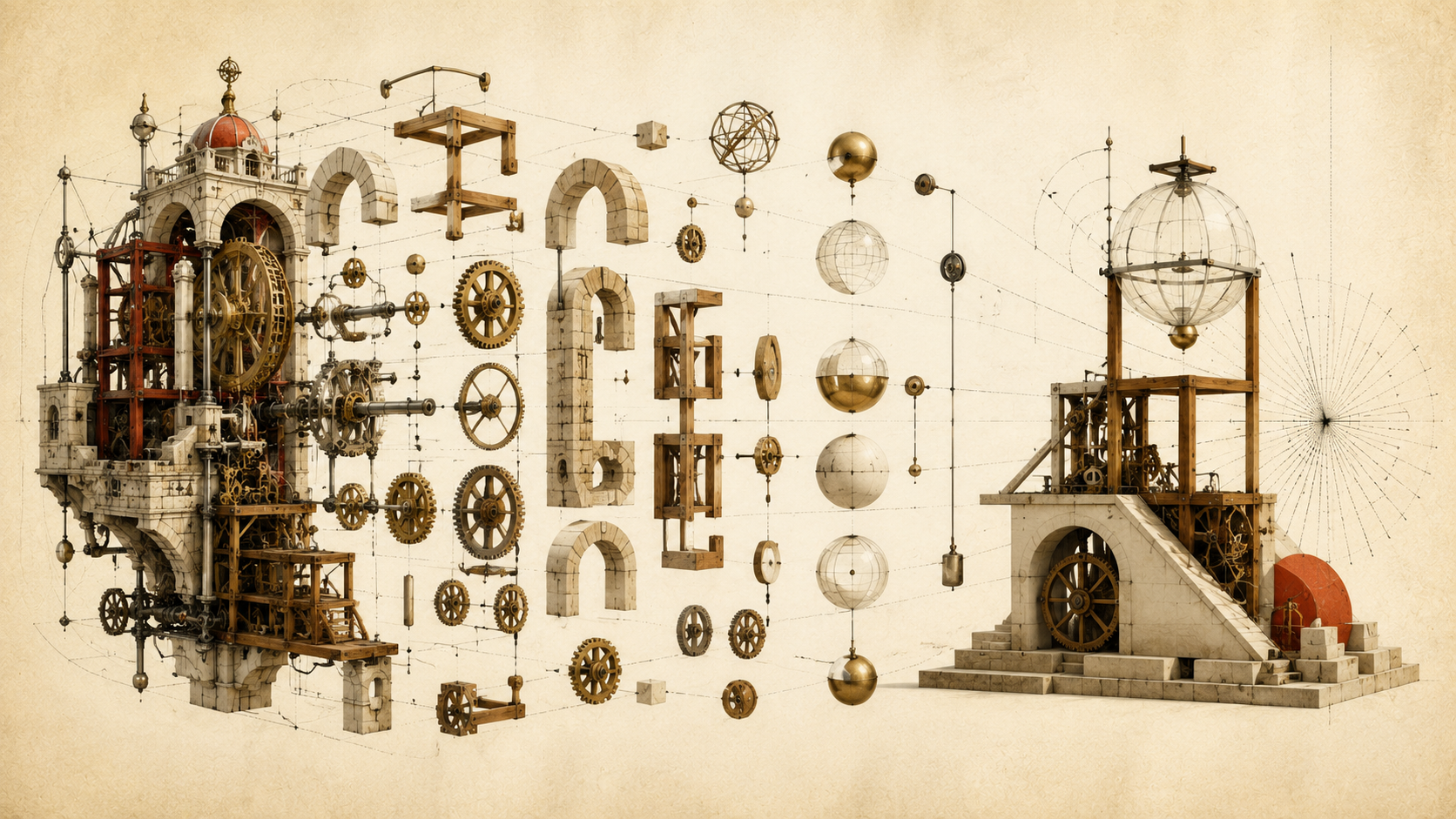
This is the intellectual equivalent of taking a machine apart and laying every component on the floor.
Step 6: Rebuild From the Ground Up
Now comes the creative stage.
Ask:
If we had these fundamental requirements but none of the existing conventions, what might we build?
This is where AI’s ability to generate possibilities becomes particularly useful.
AI Prompt: Rebuild the Solution
These are the fundamental requirements we have identified:
[requirements]
Generate five substantially different ways of satisfying them. Do not begin from the existing industry solution. At least two approaches should deliberately ignore conventional practice while still respecting genuine constraints.
Notice that we ask for substantially different approaches.
Otherwise, AI often produces five minor variations of essentially the same idea.
Step 7: Attack the New Solution
First principles thinking can create a new danger.
Once we have produced an unconventional solution, we can become emotionally attached to our cleverness.
So attack it.
AI Prompt: Try to Break It
We rebuilt the solution from first principles and arrived at:
[solution]
Now act as a sceptical critic. Identify hidden assumptions we have introduced during the rebuilding process, practical reasons this might fail and advantages of the conventional approach we may have underestimated.
This matters because conventions sometimes exist for good reasons.
Not every tradition is stupidity inherited from the past.
Sometimes thousands of people tried alternatives and discovered why the current approach works.
Step 8: Test the Cheapest Important Assumption
You rarely need to implement the entire new solution immediately.
Instead ask:
What assumption could destroy this idea if it proves false?
Test that first.
AI Prompt: Find the Critical Test
For this proposed solution:
[solution]
Identify the three assumptions most likely to determine whether it succeeds or fails. Rank them by importance and suggest the cheapest, fastest ethical way to test each before committing significant resources.
This turns philosophical reasoning into practical experimentation.
A Complete First Principles AI Prompt
If you want to run the entire process in one conversation, try this:
Help me analyse a problem using first principles thinking.
The problem is:
[describe problem]
Do not jump immediately to solutions.
Guide me through the process one stage at a time:
- Define the problem precisely.
- Separate facts from assumptions.
- Question why each supposed requirement exists.
- Distinguish genuine constraints from conventions.
- Reduce the problem to fundamental requirements.
- Rebuild possible solutions from those fundamentals.
- Challenge the new solutions.
- Identify the cheapest tests for the most important assumptions.
Ask me questions throughout. Do not proceed to the next stage until we have examined my answers.
The last instruction is particularly useful.
You want a conversation, not an enormous AI-generated report that gives the appearance of thinking without requiring much thought from you.
Example: Using First Principles Thinking on a Career Problem
Imagine someone says:
“I need to find a better job.”
First principles thinking begins by questioning the formulation.
Why?
“Because I hate my job.”
What specifically do you hate?
“The hours, lack of autonomy and commute.”
Now the original problem has changed.
The desired outcome may not actually be “a new job”.
It might be:
more control over working hours;
greater autonomy;
less commuting;
and sufficient income.
A new employer is one possible solution.
But so might negotiating different conditions, changing role within the organisation, consulting, working remotely, reducing expenses so less income is required or creating a small independent income stream.
This does not mean any of those alternatives is necessarily better.
It means the original framing was unnecessarily narrow.
That is what first principles thinking does.
It opens the problem before trying to close it.
Where First Principles Thinking Goes Wrong
First principles thinking has become fashionable in entrepreneurial culture, and that creates its own problems.
One is intellectual arrogance.
Someone discovers first principles and begins assuming every established practice exists because nobody previously thought hard enough.
That is rarely true.
Institutions, professions and traditions often contain accumulated knowledge that is not immediately obvious to outsiders.
There is even a useful principle sometimes called Chesterton’s Fence:
before removing something that appears pointless, understand why it was put there.
First principles thinking should therefore challenge convention without automatically dismissing it.
Another problem is false fundamentals.
You may confidently decide that something is a fundamental truth when it is actually another assumption.
AI can make this worse because it is capable of expressing shaky premises with impressive confidence.
Which is why first principles reasoning should involve repeated questioning and, where relevant, external verification.
When Should You Use First Principles Thinking?
You do not need it for every decision.
If you want to bake bread, following a proven recipe is probably more efficient than reconstructing baking from chemistry.
First principles thinking becomes particularly valuable when:
- conventional solutions repeatedly fail;
- costs appear inexplicably high;
- everyone insists something “has to” be done a particular way;
- technology has changed the constraints;
- you are entering a field with entrenched assumptions;
- a problem has become trapped in circular thinking;
- the consequences justify spending more time reasoning carefully.
Analogy gives us speed.
First principles can give us originality.
Wisdom involves knowing when each is appropriate.
AI Should Question Your Model, Not Become Your Model
There is a temptation with AI to believe that better prompting means receiving better answers.
Sometimes it does.
But the deeper opportunity may be receiving better questions.
When ChatGPT identifies an assumption you had not noticed, its value is not that it has solved the problem.
It has changed the problem you are capable of seeing.
That distinction matters.
If we simply replace:
“This is how everybody does it”
with:
“This is what ChatGPT told me”
we have not become first-principles thinkers.
We have merely changed authorities.
The human task remains the same:
question;
investigate;
test;
update;
decide.
From First Principles to Better Thinking
Artificial intelligence gives us unprecedented access to information and increasingly sophisticated reasoning tools.
But access to intelligence does not automatically produce good judgement.
First principles thinking offers one way of using AI more deliberately.
Strip away assumptions.
Find what is actually true.
Identify what genuinely matters.
Rebuild.
Then challenge what you have rebuilt.
This is part of the wider philosophy behind AI4Awakening.
The interesting question is not simply whether AI can solve increasingly difficult problems for us.
It is whether interacting with artificial intelligence can help us become more conscious of how we solve problems ourselves.
AI can help dismantle the structure.
But we still need to decide what deserves to be rebuilt.
Further Reading
If you want to put these ideas into practice, read 15 Best AI Prompts for Critical Thinking and Better Decisions, which includes prompts for challenging assumptions, running pre-mortems and examining alternative explanations.
You can also explore Mental Models and AI for a broader toolkit of thinking frameworks, and Cognitive Biases and AI for ways our own reasoning can distort how we interpret information.
The wider AI4Awakening project explores the same underlying question: how can we use increasingly intelligent machines not merely to automate human thought, but to improve it?