We live in the most information-rich period in human history.
At any moment, we can access more knowledge than entire civilizations possessed just a few generations ago.
Search engines, social media, podcasts, books, videos, and now artificial intelligence provide a constant stream of information.
Yet despite having access to more knowledge than ever before, many people still struggle to make good decisions.
Why?
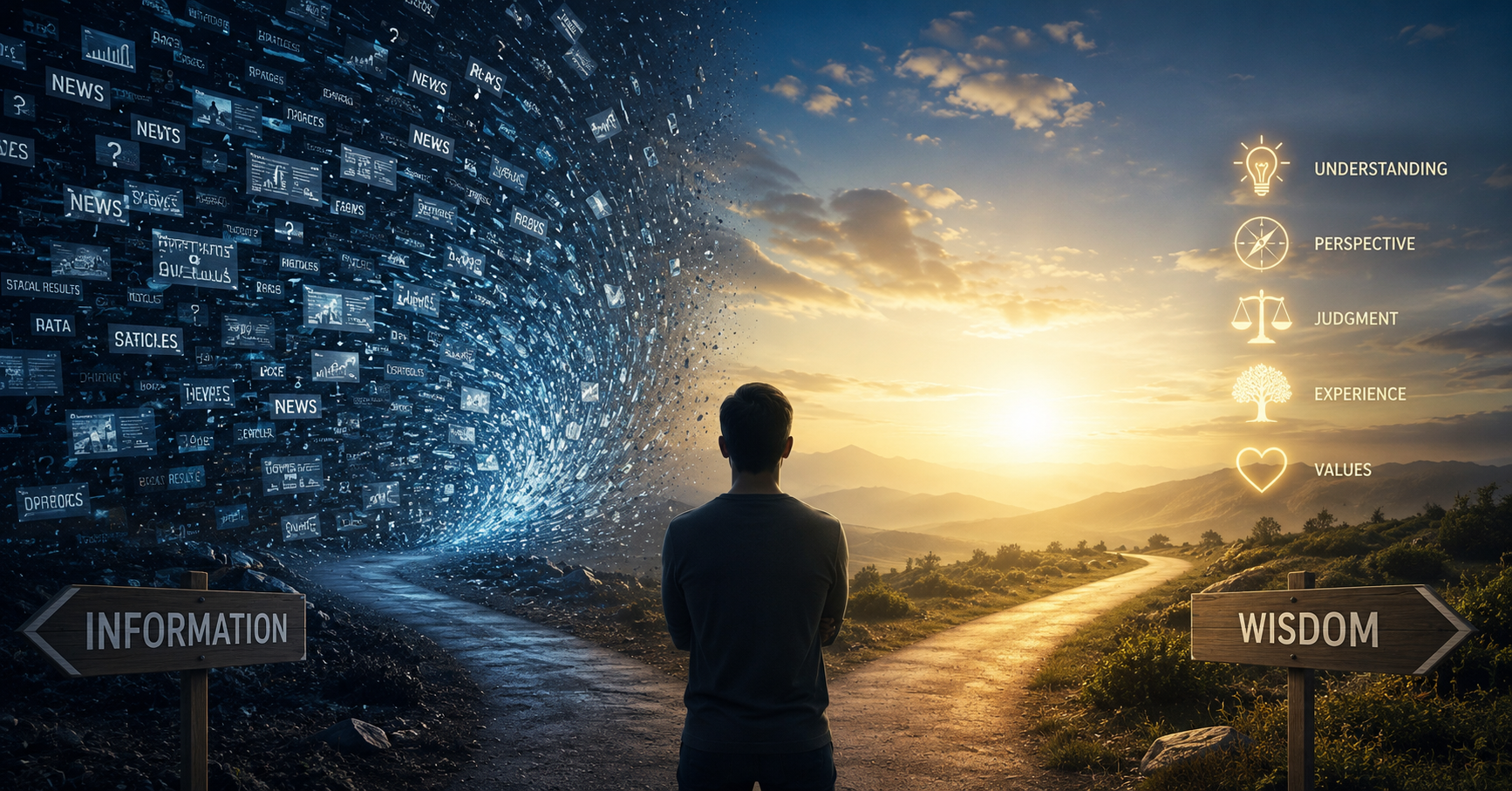
Because information and wisdom are not the same thing.
Understanding the difference may be one of the most important skills we can develop in the modern world.
Read: AI as a Thinking Partner: The Most Powerful Use of Artificial Intelligence
The Information Explosion
For thousands of years, information was scarce.
Books were expensive.
Education was limited.
Knowledge travelled slowly.
Today, the challenge is the opposite.
We are surrounded by information.
News notifications arrive every hour.
Social media presents endless opinions.
Search engines provide millions of answers in seconds.
Artificial intelligence can generate entire reports instantly.
The problem is no longer finding information.
The problem is knowing what to do with it.
Read: How AI Can Improve Self-Awareness and Personal Growth
What Is Information?
Information is raw knowledge.
It consists of facts, data, observations, statistics, and ideas.
Information answers questions such as:
- What happened?
- When did it happen?
- Who was involved?
- What are the available options?
Information is valuable because it expands our awareness.
Without information, we cannot understand the world around us.
However, information alone does not guarantee understanding.
Someone can know many facts and still make poor decisions.
Someone can consume endless content and still lack clarity.
This is because information is only the first step.
Read: The Socratic Method and AI: How Better Questions Create Better Thinking
What Is Wisdom?
Wisdom is the ability to apply knowledge effectively.
It involves judgment.
Perspective.
Experience.
Reflection.
Wisdom answers different questions:
- What actually matters here?
- What are the long-term consequences?
- Which option aligns with my values?
- What am I overlooking?
While information accumulates, wisdom integrates.
Information fills the mind.
Wisdom organizes it.
Information provides possibilities.
Wisdom provides direction.
Read: AI and Decision-Making: How to Think More Clearly in a Complex World
Why More Information Doesn’t Always Help
Many people assume that more information automatically leads to better decisions.
In reality, the opposite is often true.
When we are overloaded with information:
- We become overwhelmed.
- We struggle to prioritize.
- We second-guess ourselves.
- We become distracted by irrelevant details.
- We delay making decisions.
Psychologists sometimes refer to this as analysis paralysis.
Instead of gaining clarity, we become trapped in endless evaluation.
More data does not necessarily produce better thinking.
Sometimes it simply creates more noise.
Read: The Hidden Cost of Constant Distraction (And How to Reclaim Your Focus)
The Modern Challenge
The greatest challenge of the information age is not acquiring knowledge.
It is processing it.
This is where many people struggle.
We consume information continuously but spend very little time reflecting on it.
We read.
We watch.
We listen.
We scroll.
But we rarely pause to ask:
What does this actually mean?
How does it connect to what I already know?
How should it influence my decisions?
Wisdom emerges through reflection, not consumption.
Where AI Fits In
Artificial intelligence is often viewed as an information tool.
And it certainly excels at providing information.
It can summarize articles.
Generate reports.
Answer questions.
Analyze large amounts of data.
But its greatest value may lie elsewhere.
Used intentionally, AI can help transform information into understanding.
Rather than simply providing answers, it can:
- Organize complex ideas
- Highlight assumptions
- Compare perspectives
- Clarify reasoning
- Identify blind spots
- Encourage deeper reflection
This is one reason I increasingly view AI as a thinking partner rather than merely a productivity tool.
Read More: AI as a Thinking Partner: The Most Powerful Use of Artificial Intelligence
The Difference in Practice
Imagine two people facing an important life decision.
Both have access to the same information.
Both can research the options.
Both can gather facts and opinions.
Yet one consistently makes better decisions than the other.
Why?
The difference is rarely intelligence.
The difference is often wisdom.
One person simply processes the information more effectively.
They consider context.
They examine assumptions.
They think long-term.
They reflect before acting.
Wisdom is not about knowing more.
It is about understanding more deeply.
Developing Wisdom in the Age of AI
Technology will continue to make information easier to access.
The competitive advantage of the future may not be knowledge itself.
It may be the ability to transform knowledge into understanding.
This requires:
- Critical thinking
- Reflection
- Self-awareness
- Good judgment
- Meaningful questions
These skills become increasingly valuable as information becomes increasingly abundant.
In a world overflowing with answers, the ability to ask better questions may become one of the most important forms of wisdom.
Read More: The Socratic Method and AI: How Better Questions Create Better Thinking
Information, Wisdom, and Self-Awareness
One of the biggest differences between information and wisdom is self-awareness.
Information tells us about the world.
Wisdom helps us understand ourselves.
Many poor decisions are not caused by a lack of knowledge.
They are caused by emotional reactions, unconscious assumptions, or a lack of reflection.
Developing greater self-awareness helps us recognise these patterns and make better choices.
Read More: How AI Can Improve Self-Awareness and Personal Growth
Why Human Judgment Still Matters
Artificial intelligence is powerful.
But it is not wise.
It has no lived experience.
No values.
No personal responsibility.
Human judgment remains essential.
The goal is not to replace human thinking.
The goal is to improve it.
The best results come when AI and human judgment work together.
AI provides perspective.
Humans provide meaning.
Read More: The Difference Between Intelligence and Wisdom
Final Thoughts
Information is abundant.
Wisdom is rare.
Information tells us what is happening.
Wisdom helps us understand why it matters.
Information expands possibilities.
Wisdom guides decisions.
As artificial intelligence becomes more powerful, the goal should not simply be to accumulate more knowledge.
The goal should be to think more clearly.
To understand more deeply.
And to make better decisions.
Because ultimately, wisdom is not about what we know.
It is about what we do with what we know.
Related Articles
- AI as a Thinking Partner: The Most Powerful Use of Artificial Intelligence
- The Socratic Method and AI: How Better Questions Create Better Thinking
- How AI Can Improve Self-Awareness and Personal Growth
- Thinking Clearly in the Age of Information Overload
- Why Most People Use AI Wrong
- AI and Critical Thinking: The Skill That Matters Most
- The Difference Between Intelligence and Wisdom
- How Better Questions Create Better Decisions