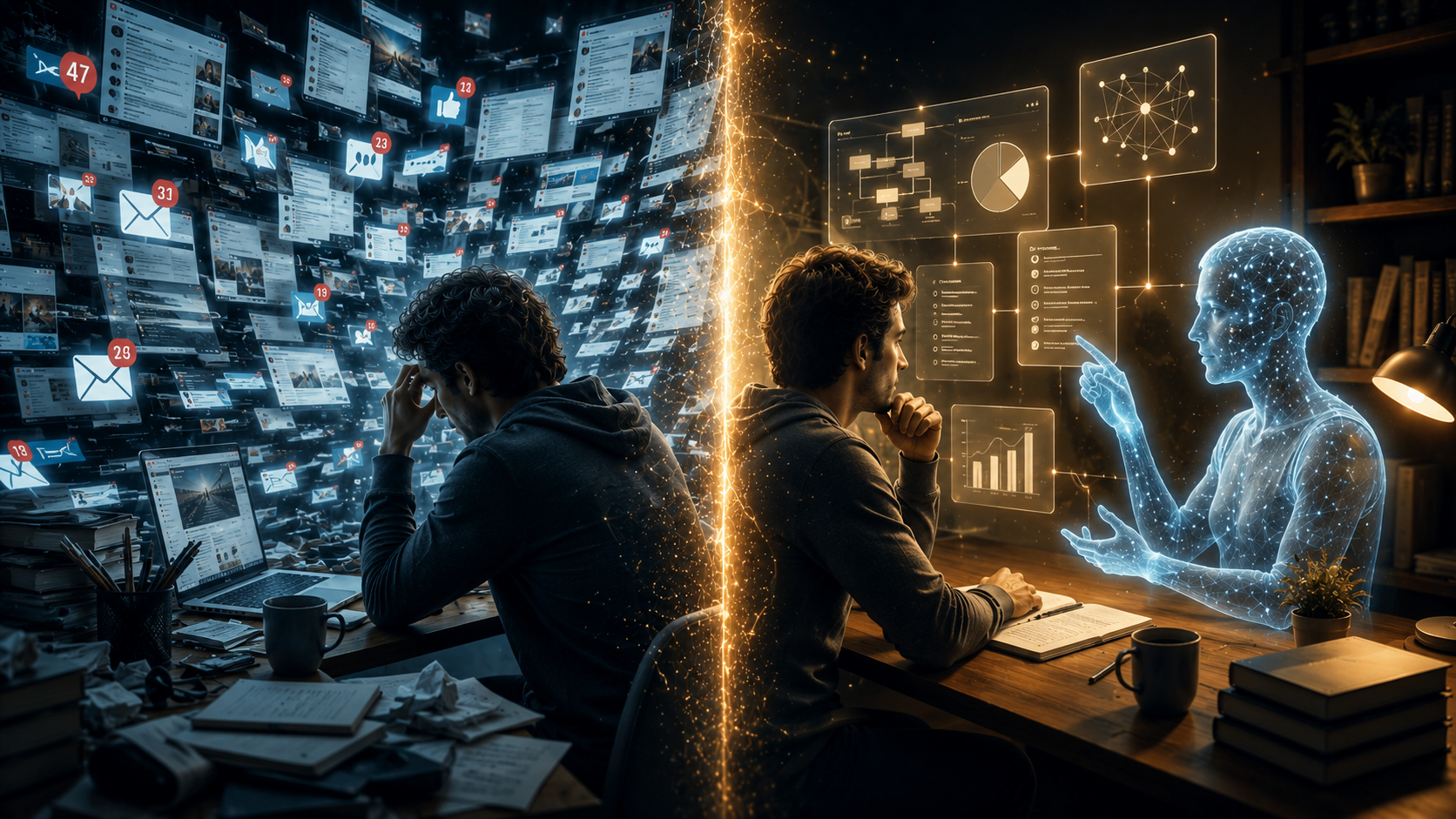
Never before in human history have we had access to so much information.
With a few taps on a phone, we can access:
- News from around the world
- Millions of books
- Scientific research
- Expert opinions
- Videos and podcasts
- Endless social media content
On the surface, this seems like an incredible advantage.
More information should lead to better decisions.
Yet many people feel overwhelmed, distracted, and uncertain.
Why?
Because information alone does not create clarity.
The Information Paradox
Most people assume that confusion comes from a lack of information.
Often the opposite is true.
The more information we consume, the harder it becomes to identify what actually matters.
We become trapped in analysis rather than action.
Instead of making decisions, we keep researching.
Instead of moving forward, we keep gathering information.
This creates what psychologists call analysis paralysis.
Read: Information vs Wisdom: Why More Knowledge Doesn’t Always Lead to Better Decisions
The Human Brain Wasn’t Designed For Infinite Information
For most of human history, information was scarce.
Today, it is abundant.
Our brains evolved to process limited amounts of information.
They did not evolve to handle:
- Hundreds of daily notifications
- Endless news feeds
- Constant social media updates
- Thousands of competing opinions
As information increases, attention becomes the scarce resource.
Why More Information Often Creates Worse Decisions
When faced with too much information, people often:
- Become overwhelmed
- Delay decisions
- Focus on irrelevant details
- Struggle to identify priorities
- Experience greater anxiety
This creates the illusion of progress.
It feels productive.
But often it simply creates mental clutter.
Read: AI and Decision-Making: How to Think More Clearly in a Complex World
The Difference Between Information and Wisdom
One of the biggest mistakes people make is confusing information with wisdom.
Information answers:
“What happened?”
Wisdom asks:
“What matters?”
Information collects facts.
Wisdom identifies meaning.
Information expands knowledge.
Wisdom improves judgment.
Read: AI as a Thinking Partner: The Most Powerful Use of Artificial Intelligence
How AI Can Help Reduce Information Overload
Used correctly, AI can act as a filter rather than another source of noise.
It can help:
- Summarise large amounts of information
- Organise complex ideas
- Identify key themes
- Compare perspectives
- Highlight important factors
The goal is not to consume more information.
The goal is to understand what is already available.
From Information Consumption to Reflection
Many people spend hours consuming information every day.
Very few spend time reflecting on it.
Reflection is where learning occurs.
Without reflection:
- Knowledge remains disconnected
- Insights are forgotten
- Understanding remains shallow
AI can encourage reflection by asking questions such as:
- What is the key lesson here?
- How does this connect to previous knowledge?
- What assumptions am I making?
- What matters most?
Read: How AI Can Improve Self-Awareness and Personal Growth
Clarity Comes From Subtraction
Many people search for clarity by adding more information.
Often clarity comes from removing information.
The most effective thinkers learn to:
- Ignore distractions
- Focus on essentials
- Simplify complexity
- Prioritise what matters
This is one of the most valuable skills in modern life.
Read: The Hidden Cost of Constant Distraction (And How to Reclaim Your Focus)
The Role of AI in Clear Thinking
The best use of AI is not generating more content.
It is creating more clarity.
Instead of asking:
“What else should I know?”
Ask:
“What is most important?”
Instead of collecting more information, focus on improving understanding.
Read: AI as a Thinking Partner: The Most Powerful Use of Artificial Intelligence
Read: Why Most People Use AI Wrong
Final Thoughts
Information is abundant.
Attention is limited.
Wisdom is rare.
The challenge of modern life is no longer finding information.
It is identifying what matters.
Artificial intelligence can help.
Not by giving us more information.
But by helping us organise, simplify, and understand the information we already have.
Because better decisions rarely come from knowing more.
They come from understanding better.