Communication is one of the most important skills in life.
Relationships, careers, leadership, business, and personal growth all depend on our ability to express ideas clearly and understand others effectively.
Yet communication is often harder than it seems.
Many people know what they want to say but struggle to organise their thoughts.
Others become emotional, defensive, or unclear during important conversations.
This is where artificial intelligence can become surprisingly useful.
Not because it communicates for us.
But because it helps us communicate more clearly ourselves.
Communication Begins With Clear Thinking
Poor communication is often a thinking problem rather than a speaking problem.
When our thoughts are disorganised, our words become disorganised too.
We jump between ideas.
We leave out important details.
We assume others understand what we mean.
The result is confusion.
AI can help by acting as a thinking partner before communication happens.
Instead of immediately sending an email, writing a message, or having a difficult conversation, you can use AI to organise your thinking first.
Read: AI as a Thinking Partner: The Most Powerful Use of Artificial Intelligence
Using AI to Structure Ideas
One of the most valuable uses of AI is helping organise complex thoughts.
For example, you might ask:
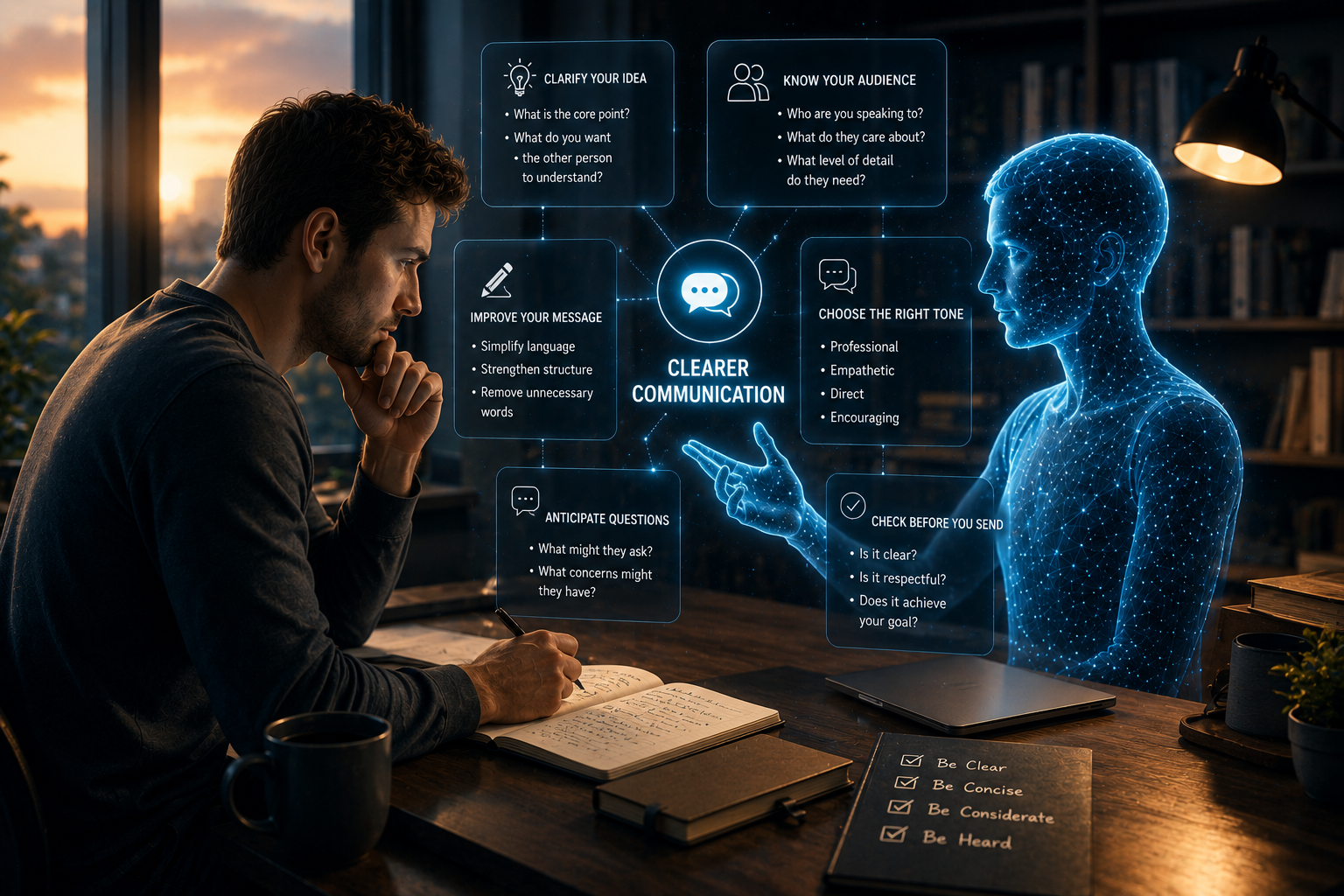
- What is the core point I am trying to communicate?
- What assumptions am I making?
- What information is missing?
- What questions might the other person have?
These simple exercises often reveal weaknesses in our thinking.
Once our thinking becomes clearer, communication naturally improves.
Read: Information vs Wisdom: Why More Knowledge Doesn’t Always Lead to Better Decisions
Improving Written Communication
Many people already use AI to write emails and documents.
However, the greatest benefit is not having AI write for you.
It is using AI to improve your own writing.
You can ask AI to:
- Simplify complicated language
- Improve structure
- Remove unnecessary words
- Make a message more professional
- Adjust tone for different audiences
Over time, this becomes a learning process rather than a shortcut.
You begin to understand what makes communication effective.
Preparing for Difficult Conversations
Some conversations are emotionally charged.
Conflict with colleagues.
Relationship discussions.
Important decisions.
High-stakes negotiations.
In these situations, AI can act as a rehearsal partner.
You can explore different approaches and perspectives before the conversation happens.
AI can help identify:
- Emotional triggers
- Blind spots
- Alternative viewpoints
- Potential misunderstandings
This creates space for more thoughtful communication.
Read: AI and Decision-Making: How to Think More Clearly in a Complex World
Communication and Self-Awareness
Many communication problems arise because we do not fully understand our own motivations.
We react automatically.
We become defensive.
We interpret situations through existing assumptions.
Self-awareness improves communication because it helps us recognise these patterns.
AI can support reflection by helping us examine our thinking more objectively.
Read: How AI Can Improve Self-Awareness and Personal Growth
The Future of Communication
As AI becomes more powerful, many people worry about machines replacing human interaction.
I believe the opposite is more likely.
Used correctly, AI can help people become better communicators.
It can encourage clearer thinking.
Better listening.
More thoughtful responses.
Greater understanding.
The goal is not to replace human communication.
The goal is to improve it.
Read: Why Most People Use AI Wrong
Final Thoughts
The quality of our lives is deeply connected to the quality of our communication.
When we think more clearly, we communicate more effectively.
When we communicate more effectively, relationships improve, decisions improve, and opportunities increase.
AI can support this process.
Not by speaking for us.
But by helping us understand ourselves and others more clearly.
And that may become one of its most valuable roles.
Read: The Socratic Method and AI: How Better Questions Create Better Thinking