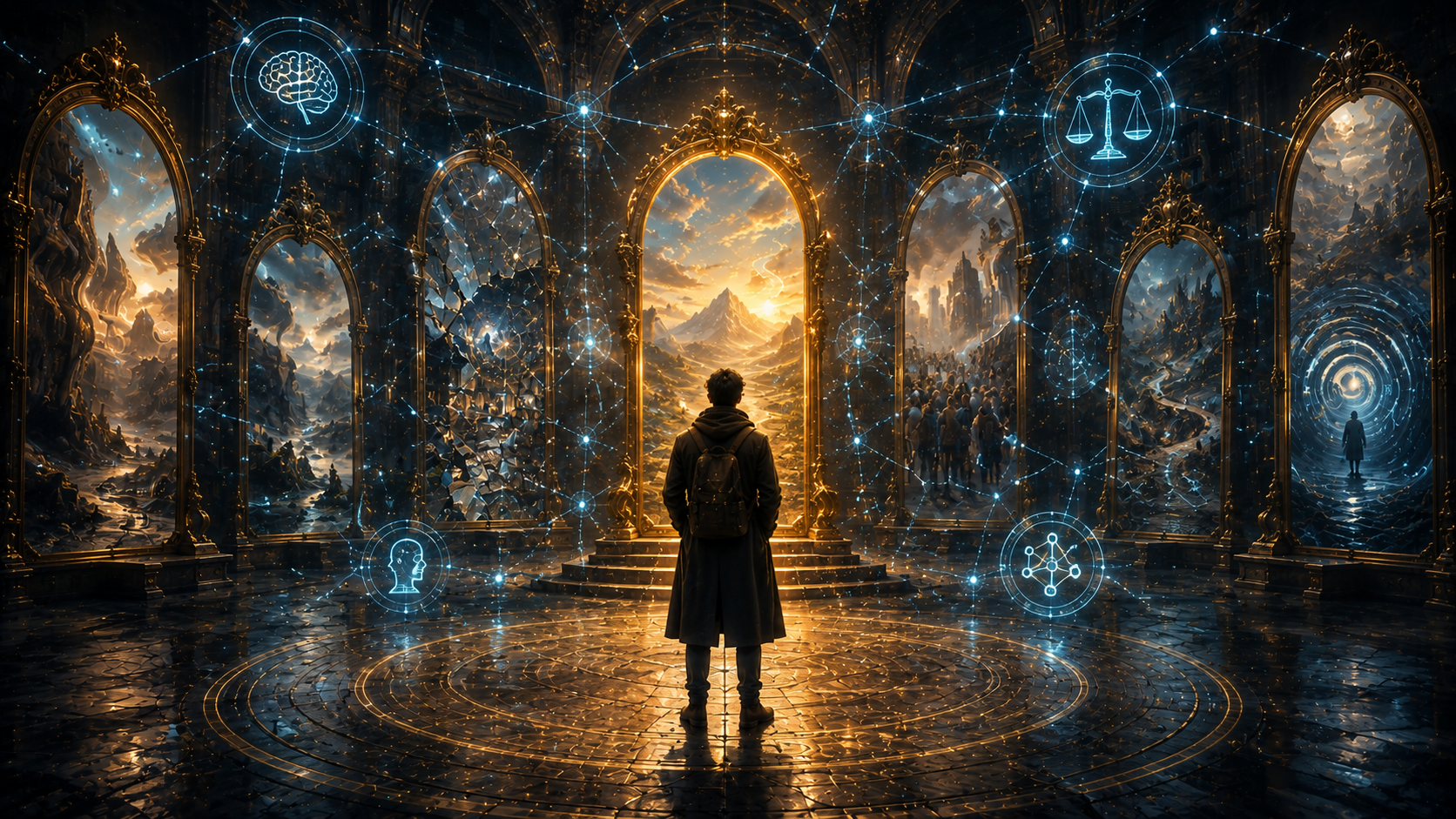
You probably think you’re a rational person.
Most of us do.
We like to believe that we examine the evidence, consider our options, and then reach logical conclusions.
But the human mind doesn’t quite work that way.
Our thinking is influenced by hundreds of mental shortcuts known as cognitive biases.
They affect what we notice.
What we remember.
Who we trust.
What we believe.
And ultimately, the decisions we make.
The interesting question in the age of artificial intelligence is this:
Can AI help us recognise the biases we struggle to see in ourselves?
Used carefully, I believe it can.
What Are Cognitive Biases?
Cognitive biases are predictable patterns in human thinking that can distort our judgement.
They’re not necessarily signs of poor intelligence.
They’re partly the result of an extraordinarily useful feature of the human brain: its ability to make decisions quickly.
Imagine having to consciously analyse every piece of information you encounter.
Life would become impossible.
Instead, the brain develops shortcuts.
Most of the time, these shortcuts work remarkably well.
Sometimes, however, they lead us in the wrong direction.
And because these processes often happen unconsciously, we may never realise that our thinking has been influenced.
Confirmation Bias: We Look for Evidence That We’re Right
Perhaps the best-known cognitive bias is confirmation bias.
Once we form an opinion, we naturally notice information that supports it.
At the same time, we may dismiss information that challenges it.
Suppose you believe a particular diet is extremely healthy.
You search online and find ten articles supporting your position.
That feels convincing.
But what did you search for?
If your search was:
“Benefits of this diet”
you effectively asked the internet to confirm your existing belief.
A better question would be:
“What is the strongest evidence both for and against this diet?”
That simple change can completely alter the information you encounter.
AI can be extremely useful here.
Instead of asking it to validate your opinion, ask it to challenge you.
The Availability Bias
Our brains tend to give greater importance to information that comes easily to mind.
This is known as the availability heuristic.
Imagine hearing several dramatic stories about shark attacks.
You may suddenly feel that swimming in the ocean is extremely dangerous.
The stories are memorable.
That doesn’t necessarily mean the risk is statistically high.
The same phenomenon happens constantly with news and social media.
Dramatic events receive disproportionate attention precisely because they’re dramatic.
Our perception of reality can therefore become shaped by what is memorable rather than what is probable.
AI can help by asking a simple question:
What does the broader evidence show?
Anchoring: The First Number Changes Your Thinking
Imagine someone asks:
“Do you think this house is worth more or less than $1 million?”
Then they ask you to estimate its value.
That first number has already influenced you.
It’s an anchor.
Even completely arbitrary numbers can affect subsequent judgements.
Anchoring appears everywhere:
Prices.
Salary negotiations.
Property valuations.
Investment decisions.
Business negotiations.
Recognising the anchor allows you to ask a better question:
If I had never seen that first number, how would I evaluate this situation?
The Sunk Cost Fallacy
You’ve spent three years building a business.
It isn’t working.
Do you continue?
One argument might be:
“I’ve already invested three years. I can’t stop now.”
But those three years are gone regardless of what you decide next.
The rational question is:
Knowing everything I know today, would I choose to invest another year?
This is the sunk cost fallacy.
We become attached to previous investments of time, money, energy, or emotion.
Sometimes persistence is admirable.
Sometimes persistence simply means continuing a mistake.
Wisdom means learning to distinguish between the two.
Loss Aversion
Humans generally dislike losing something more than they enjoy gaining something of equivalent value.
Losing $100 often feels considerably worse than gaining $100 feels good.
This can influence decisions in subtle ways.
We hold investments too long.
Stay in situations that no longer serve us.
Avoid opportunities because the possibility of failure feels more powerful than the possibility of success.
AI can help explore both sides of a decision.
Ask:
What might I lose by acting?
Then ask:
What might I lose by doing nothing?
The second question is often forgotten.
The Dunning-Kruger Effect
One of the stranger characteristics of knowledge is that learning a little can sometimes increase confidence faster than understanding.
When we first encounter a subject, it can appear relatively simple.
The deeper we explore it, the more complexity becomes visible.
Experts often recognise uncertainty because they understand how much there is to know.
This creates an important principle for using AI:
Fast answers can create an illusion of understanding.
AI can explain almost anything in seconds.
But reading an explanation isn’t the same as developing expertise.
Information is not understanding.
And understanding is not wisdom.
AI Has Biases Too
There’s an important warning here.
AI isn’t an objective machine standing outside human bias.
AI systems learn from human-created information.
That information can contain cultural assumptions, historical distortions, incomplete evidence, and conflicting viewpoints.
AI can also be influenced by the way a question is framed.
Ask:
“Why is this idea correct?”
and you may receive arguments supporting it.
Ask:
“Why is this idea wrong?”
and you may receive arguments attacking it.
This means AI should never become an unquestioned authority.
It should become something much more useful:
A tool for examining ideas.
Don’t Ask AI to Agree With You
One of the worst ways to use artificial intelligence is as an agreement machine.
It feels good.
But it doesn’t improve your thinking.
Instead, deliberately introduce intellectual resistance.
Try prompts such as:
“I believe X. Give me the strongest arguments that I might be wrong.”
Or:
“Analyse my reasoning and identify any cognitive biases that may be influencing me.”
Or:
“What assumptions am I treating as facts?”
Suddenly AI becomes something different.
Not a machine that provides answers.
A machine that helps you examine your thinking.
Five AI Prompts for Challenging Cognitive Bias
Here are five prompts worth saving.
1. The Bias Detector
“Analyse my reasoning below. Identify any cognitive biases, assumptions, emotional influences, or logical weaknesses that may be affecting my judgement. Explain them without automatically assuming my conclusion is wrong.”
2. The Devil’s Advocate
“I currently believe the following. Construct the strongest reasonable argument against my position. Don’t create weak objections. Give me the arguments an intelligent and informed critic would make.”
3. The Missing Perspective
“What perspectives or interpretations of this situation might I be overlooking? Include viewpoints that challenge my current assumptions.”
4. The Evidence Test
“Separate what I know from what I assume. What evidence supports my conclusion, what evidence contradicts it, and what additional information would most improve my judgement?”
5. The Decision Audit
“Review this decision for confirmation bias, anchoring, sunk cost fallacy, loss aversion, availability bias, and overconfidence. Tell me which biases appear most relevant and why.”
These prompts don’t make AI the decision-maker.
They make AI a mirror.
Self-Awareness Is the Real Defence Against Bias
You will never eliminate cognitive bias completely.
Neither will I.
Bias is part of being human.
The goal isn’t perfect rationality.
The goal is awareness.
When you recognise that your own thinking can mislead you, something important changes.
You become more curious.
More willing to question yourself.
More comfortable saying:
“I might be wrong.”
Those four words are surprisingly powerful.
They create space for learning.
Intelligence Doesn’t Protect You From Bias
There’s another uncomfortable truth.
Being intelligent doesn’t necessarily make you less biased.
Sometimes intelligence simply makes you better at defending the beliefs you already hold.
You become more skilled at constructing arguments.
More capable of finding supporting evidence.
More persuasive when explaining your position.
That isn’t necessarily wisdom.
Wisdom requires something harder:
The willingness to use your intelligence against your own assumptions.
AI Can Strengthen Bias or Challenge It
This is one of the great contradictions of artificial intelligence.
Used one way, AI can become an extraordinarily sophisticated confirmation-bias machine.
You tell it what you believe.
It generates convincing arguments supporting you.
You feel increasingly certain.
Used differently, the same technology can challenge your assumptions.
It can introduce opposing perspectives.
Expose weak reasoning.
Ask uncomfortable questions.
Reveal possibilities you hadn’t considered.
The technology hasn’t changed.
Your relationship with it has.
Better Thinking Requires Friction
We naturally prefer ideas that confirm what we already believe.
But intellectual growth often happens when something creates resistance.
A question we can’t immediately answer.
An argument we can’t easily dismiss.
Evidence that doesn’t fit our worldview.
A perspective we’ve never considered.
That friction can feel uncomfortable.
But discomfort isn’t always a warning sign.
Sometimes it’s evidence that genuine thinking has begun.
Final Thoughts
Cognitive biases aren’t defects that affect other people.
They affect all of us.
They shape our beliefs, decisions, relationships, and understanding of the world.
Artificial intelligence won’t remove them.
But it can give us something previous generations rarely had:
A thinking partner capable of challenging our assumptions whenever we ask.
The crucial words are:
Whenever we ask.
If we use AI merely to confirm what we already believe, technology may make us more certain without making us wiser.
If we use it to question ourselves, explore opposing arguments, and reveal our blind spots, something very different becomes possible.
AI doesn’t have to tell us what to think.
Perhaps its more important role is helping us notice how we think.
And becoming aware of our own thinking may be one of the first steps toward wisdom.
Continue Reading
If you enjoyed this article, continue with: