Every day we make decisions.
Some are small.
Others can change the course of our lives.
Which career should I pursue?
Should I start a business?
Should I move country?
Should I invest my time, money, or energy in a particular opportunity?
The quality of our lives is often determined by the quality of our decisions.
Yet most people have never been taught how to think effectively about decision-making.
This is where artificial intelligence can become surprisingly useful.
Not because it makes decisions for us.
But because it helps us think more clearly.
Why Smart People Still Make Bad Decisions
Intelligence does not guarantee good judgment.
History is filled with highly intelligent people who made poor decisions.
The problem is that human thinking is affected by:
- Emotions
- Biases
- Assumptions
- Limited information
- Stress
- Time pressure
When these factors combine, even intelligent people can make choices they later regret.
Often the issue is not intelligence.
It is perspective.
Read: Information vs Wisdom: Why More Knowledge Doesn’t Always Lead to Better Decisions
The Hidden Influence of Cognitive Bias
Our brains use mental shortcuts to simplify complex situations.
These shortcuts are known as cognitive biases.
Examples include:
Confirmation Bias
Seeking information that supports existing beliefs.
Availability Bias
Giving too much weight to recent or memorable events.
Loss Aversion
Fearing losses more than valuing gains.
Anchoring
Becoming overly influenced by the first piece of information encountered.
These biases affect everyone.
Often without us noticing.
Read: How AI Can Improve Self-Awareness and Personal Growth
AI as a Decision-Making Partner
One of AI’s greatest strengths is that it can examine problems from multiple perspectives.
For example, you might ask:
“What arguments exist against my current position?”
“What risks am I overlooking?”
“What assumptions am I making?”
“What would someone who disagrees with me say?”
These questions force us to expand our thinking.
Often the goal is not to find the perfect answer.
It is to improve the quality of the decision-making process.
Read: AI as a Thinking Partner: The Most Powerful Use of Artificial Intelligence
Read: AI as a Thinking Partner: The Most Powerful Use of Artificial Intelligence
The Importance of Challenging Assumptions
Many poor decisions originate from assumptions that are never questioned.
For example:
- Assuming a promotion will make us happier.
- Assuming more money will solve a problem.
- Assuming a relationship will change.
- Assuming a business idea will succeed because we like it.
AI can help identify these assumptions.
Simply asking:
“What assumptions am I making?”
can reveal weaknesses in our thinking that would otherwise remain hidden.
Decision-Making Is Not About More Information
When faced with uncertainty, most people seek more information.
Sometimes this helps.
Often it doesn’t.
Many decisions are delayed not because information is lacking.
But because clarity is lacking.
This is an important distinction.
Read: Information vs Wisdom: Why More Knowledge Doesn’t Always Lead to Better Decisions
The challenge is rarely finding information.
The challenge is interpreting it wisely.
Exploring Multiple Perspectives
One powerful use of AI is perspective generation.
Imagine you’re considering a major life decision.
You could ask AI to analyse the situation from several viewpoints:
- Optimistic
- Pessimistic
- Practical
- Financial
- Emotional
- Long-term
This process helps create a more complete picture.
Instead of becoming trapped inside one perspective, you gain access to many.
Read: The Socratic Method and AI: How Better Questions Create Better Thinking
Slowing Down Fast Thinking
Psychologist Daniel Kahneman described two modes of thinking:
Fast Thinking
Automatic, emotional, instinctive.
Slow Thinking
Deliberate, analytical, reflective.
Many poor decisions occur when we rely too heavily on fast thinking.
AI naturally encourages slower thinking.
It creates a pause.
A moment to reflect.
A chance to examine the situation before acting.
That pause alone can dramatically improve decision quality.
Read: The Hidden Cost of Constant Distraction (And How to Reclaim Your Focus)
Better Questions Lead to Better Decisions
The quality of our decisions is often determined by the quality of our questions.
Instead of asking:
“What should I do?”
Try asking:
“What am I overlooking?”
“What assumptions am I making?”
“What are the second-order consequences?”
“What could go wrong?”
“What would success look like in five years?”
This approach leads to deeper thinking and stronger decisions.
Read: The Socratic Method and AI: How Better Questions Create Better Thinking
AI Cannot Replace Human Judgment
AI can help analyse options.
It can identify risks.
It can explore possibilities.
But it cannot replace human judgment.
AI has no personal values.
No lived experience.
No intuition.
No responsibility for the outcome.
The final decision always belongs to the human being.
This is why the goal should never be to outsource decision-making.
The goal should be to improve it.
A Practical Decision-Making Framework
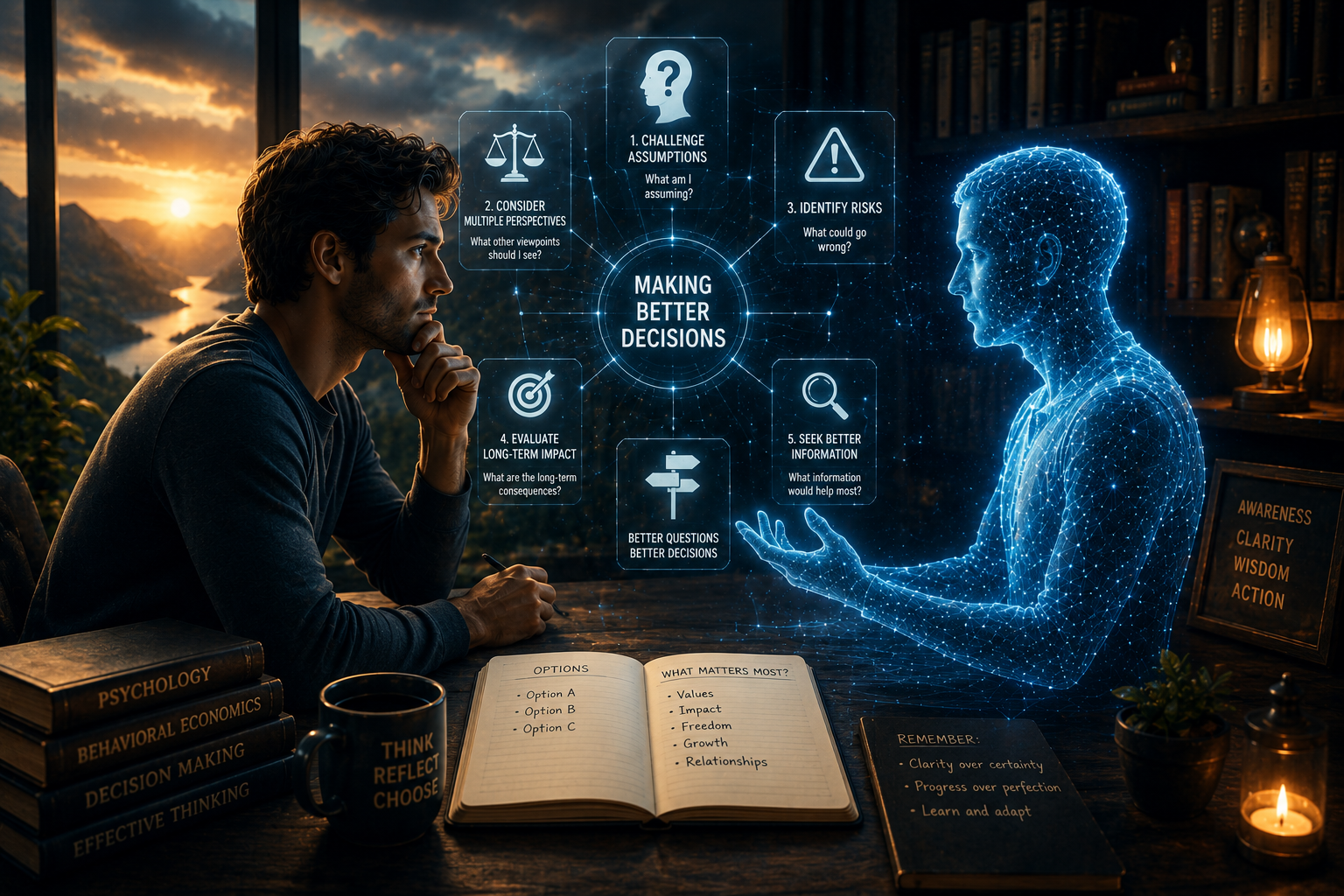
Whenever facing an important decision, try asking AI these five questions:
1. What assumptions am I making?
2. What risks am I overlooking?
3. What alternative perspectives should I consider?
4. What are the long-term consequences of each option?
5. What information would most improve this decision?
The answers often reveal insights that would otherwise remain hidden.
Final Thoughts
The future will not belong to people with the most information.
It will belong to people who can think clearly about information.
Artificial intelligence cannot make decisions for us.
But it can help us make better decisions ourselves.
Used correctly, AI becomes more than a productivity tool.
It becomes a tool for better judgment.
And better judgment often leads to a better life.