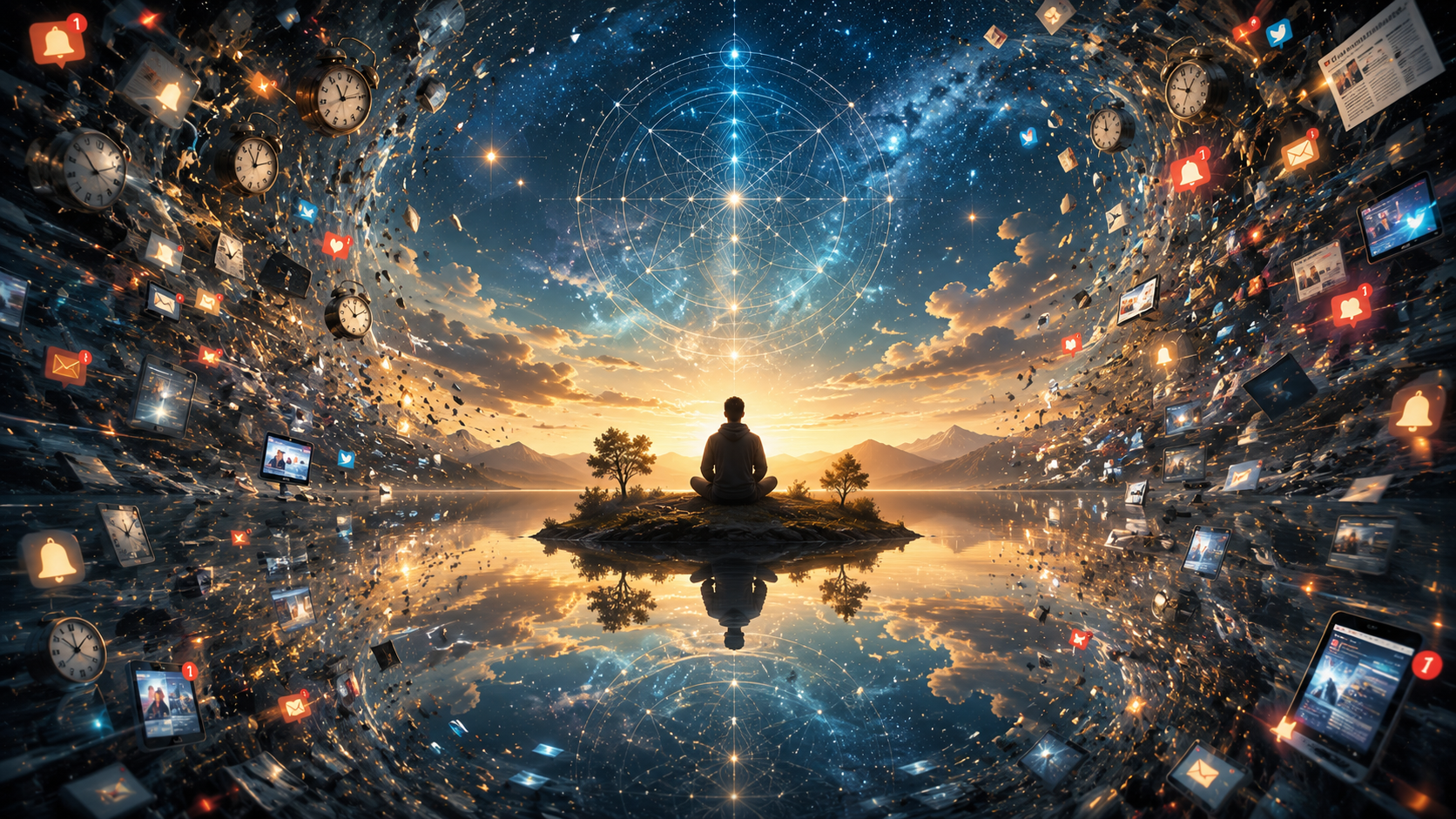
We live in an age of unprecedented access to information.
At any moment, we can search for answers, watch tutorials, read articles, listen to podcasts, scroll through social media, or ask artificial intelligence almost any question imaginable.
Yet despite having more information than any generation in history, many people feel more confused, distracted, and uncertain than ever before.
Why?
Because information and understanding are not the same thing.
Knowledge does not automatically become wisdom.
And information does not become insight without reflection.
This is what I call the Reflection Gap: the growing distance between consuming information and truly thinking about it.
What Is the Reflection Gap?
The Reflection Gap is the space between experience and understanding.
It is the difference between hearing something and learning from it.
Between reading information and integrating it into your life.
Between collecting knowledge and developing wisdom.
Most people spend a significant amount of time consuming information.
Very few spend enough time reflecting on it.
We listen to podcasts while driving.
We scroll while eating.
We check messages while watching videos.
We move rapidly from one piece of information to the next.
Rarely do we stop and ask:
- What does this actually mean?
- Do I agree with it?
- How does this apply to my life?
- What can I learn from it?
- How should it change my behaviour?
Without reflection, information simply passes through us.
Why Modern Life Makes Reflection Difficult
The modern world is designed to capture attention.
Every app, platform, notification, advertisement, and headline competes for a limited resource:
Your focus.
Technology rewards speed.
Reflection requires slowness.
Technology encourages reaction.
Reflection requires observation.
Technology promotes constant stimulation.
Reflection requires stillness.
This creates a conflict.
The very environment we live in often makes deep thinking more difficult.
The result is that many people spend their lives reacting rather than reflecting.
The Cost of Constant Consumption
Many people assume that more information automatically leads to better decisions.
In reality, the opposite is often true.
When information enters faster than it can be processed, clarity decreases.
The mind becomes crowded.
Attention becomes fragmented.
Important ideas are quickly replaced by new ones.
Instead of developing understanding, we become trapped in a cycle of endless consumption.
This is one reason why information overload has become such a widespread problem.
The issue is rarely a lack of information.
It is a lack of space to think about it.
Reflection Is Where Learning Happens
Consider the difference between two people attending the same seminar.
The first person takes notes, leaves, and immediately moves on to the next thing.
The second person spends thirty minutes reflecting.
They ask:
- What was the most important idea?
- What challenged my assumptions?
- What should I change?
- What action will I take?
Who learns more?
Almost always the second person.
Learning happens when information is processed, examined, and connected to experience.
Reflection transforms information into understanding.
The Wisdom Hidden in Silence
Throughout history, philosophers, spiritual traditions, and great thinkers have emphasised the importance of silence.
Not because silence is valuable in itself.
But because silence creates space for thought.
Many of humanity’s greatest insights emerged during periods of reflection:
- Walking alone
- Sitting quietly
- Journaling
- Meditation
- Deep conversation
- Time in nature
These activities slow the mind enough for deeper understanding to emerge.
Modern life often removes these opportunities.
As a result, many people become highly informed but poorly connected to their own thoughts.
The Relationship Between Reflection and Self-Awareness
Reflection is one of the foundations of self-awareness.
Without reflection, it becomes difficult to notice:
- Recurring patterns
- Limiting beliefs
- Emotional triggers
- Hidden assumptions
- Unconscious habits
As discussed in our article Why Self-Awareness Is the Foundation of Growth, meaningful personal development begins with understanding yourself.
Reflection creates that understanding.
It allows you to step back and observe your own thinking.
And once you can observe your thinking, you can begin to improve it.
How AI Can Help Bridge the Reflection Gap
Artificial intelligence is often blamed for increasing distraction.
In some cases, that criticism is justified.
But AI can also be used differently.
Instead of using AI only to generate answers, we can use it to deepen reflection.
For example:
- What assumptions am I making?
- What blind spots might I have?
- What themes keep appearing in my life?
- What questions should I be asking?
- What perspective am I missing?
Used this way, AI becomes less like a search engine and more like a thinking partner.
This idea is explored further in our articles AI as a Thinking Partner and AI as a Mirror for Self-Reflection.
The goal is not simply to get answers faster.
The goal is to think more deeply.
Practical Ways to Create More Reflection
The good news is that reflection does not require dramatic life changes.
Small habits can create significant results.
Create Thinking Time
Schedule ten or fifteen minutes each day with no distractions.
No phone.
No music.
No notifications.
Just thinking.
Journal Regularly
Writing helps organise thoughts and reveal patterns.
Even a few minutes each day can dramatically improve self-awareness.
Ask Better Questions
Instead of asking:
“What happened today?”
Ask:
- What did I learn?
- What surprised me?
- What challenged me?
- What would I do differently?
Spend Time in Nature
Nature naturally slows attention and encourages reflection.
Many people find their clearest thinking occurs away from screens.
Use AI Thoughtfully
Use AI to challenge assumptions and explore ideas rather than simply gathering information.
The Difference Between Information and Wisdom
Information tells you what.
Knowledge tells you how.
Wisdom tells you why.
The modern world provides endless information.
Wisdom requires reflection.
It develops slowly through observation, experience, questioning, and understanding.
This is why the ability to think deeply may become one of the most valuable skills of the future.
As artificial intelligence makes information increasingly abundant, reflection becomes increasingly important.
Final Thoughts
The greatest challenge of the information age may not be finding answers.
It may be creating space to think about them.
Most people do not suffer from a lack of knowledge.
They suffer from a lack of reflection.
The Reflection Gap grows every time we consume information without pausing to understand it.
It shrinks every time we create space for thought.
The future will belong not only to those who have access to information.
It will belong to those who can transform information into wisdom.
And that transformation begins with reflection.